
Offsites at a Remote Company
August 4, 2026
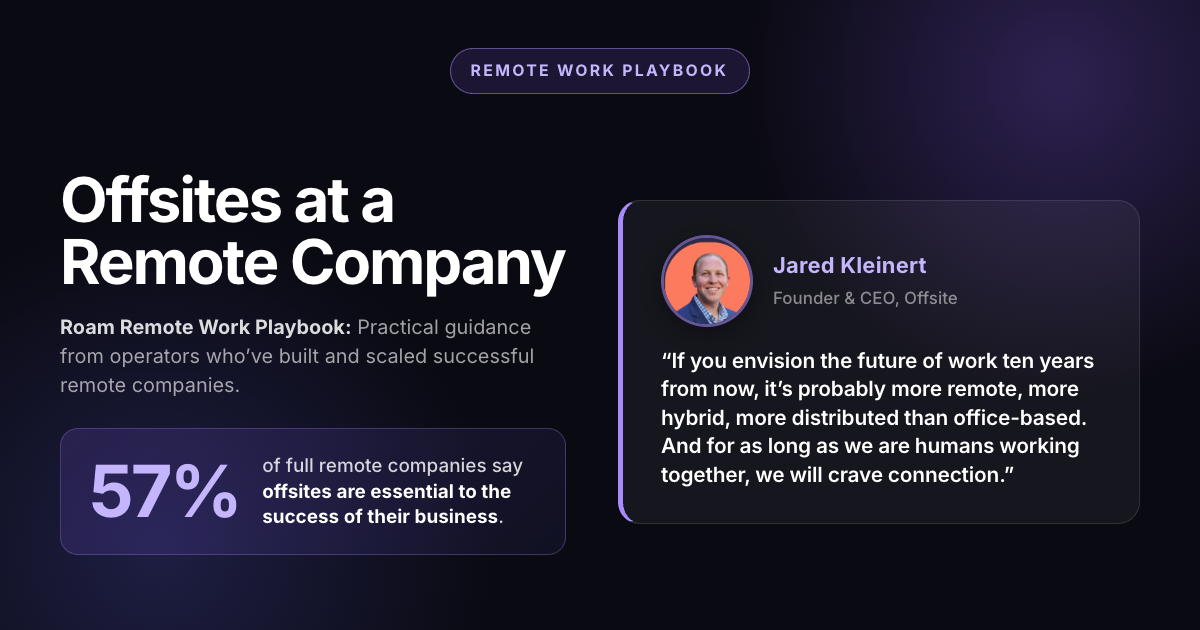
Part of the Roam Remote Work Playbook: Practical Guidance from operators who’ve built and scaled successful remote companies.
Over 57% of full remote companies say offsites are essential to the success of their business.
Jared Kleinert is the founder and CEO of Offsite, a company that plans team retreats for hundreds of remote first organizations including Perplexity, Remote, Zapier, and Roam. Before founding Offsite, Jared was employee #7 at 15Five, one of the earliest remote-first companies in tech.

“If you envision the future of work ten years from now, it’s probably more remote, more hybrid, more distributed than office-based. And for as long as we are humans working together, we will crave connection.”
—Jared Kleinert
Key Takeaways
- One company-wide offsite each year is a best practice for most remote companies.
- Leadership and high-collaboration teams (such as sales, marketing, product, and engineering) often benefit from meeting more frequently.
- Reserve in-person time for building trust, strategic planning, and decisions that are difficult to make remotely.
- Plan intentionally, but leave room for spontaneous conversations and relationship building.
- Think of offsites as a long-term investment in culture, alignment, and retention, not as a company perk.
How Often Should Remote Companies Gather?
There isn’t a single right cadence for company offsites. According to Jared Kleinert, the right schedule depends on company size, team function, and the purpose of gathering.
For companies with a few hundred employees, Kleinert considers one all-company offsite each year to be the baseline. Bringing the full team together creates benefits that extend well behind the offsite itself, from stronger employee engagement and retention to better cross-functional alignment and recruiting.
The broader principle is that offsites shouldn’t be planned out of habit or skipped because they feel optional. Each gathering should have a clear purpose, with a cadence that reflects the work each team is trying to accomplish. Kleinert also pointed to companies like Airbnb and Dropbox as useful examples. When Airbnb embraced remote-first work, CEO Brian Chesky encouraged employees to gather in person throughout the year depending on their role and team. Dropbox adopted a similar philosophy through its “90/10” model, where most work happens remotely while teams come together for a handful of intentional gatherings each year.
Why Are Offsites Worth the Investment?
For remote companies, the purpose of an offsite isn’t to compress a year’s worth of culture into a few days. The strongest distributed teams build relationships, collaborate, and stay aligned every week through intentional remote practices. An offsite should build on that foundation, not replace it.
Offsites create opportunities to deepen relationships that already exist. Teams that collaborate regularly throughout the year can use in-person time to strengthen trust, have more candid conversations, and develop the context that makes remote collaboration even more effective afterward.
That’s why the best remote companies don’t think of offsites as a substitute for culture. They’re an extension of it. The day-to-day work of building relationships, communicating effectively, and collaborating across teams still happens remotely. Offsites simply provide dedicated moments to reinforce those relationships, align around the biggest decisions, and return to remote work with greater clarity and momentum.
How Should Companies Structure an Offsite?
According to Kleinert, a successful offsite starts well before anyone boards a plane. The executive sponsor, whether that’s the CEO, CRO, or Chief People Officer, the person planning the event should first align on two things: the purpose of the offsite and the budget. Those decisions shape everything that follows.
For the typical gathering, it is recommended to resist the urge to pack every hour with presentations. Instead, the agenda should alternate between relationship building, focused work, and time for informal conversations.
Just as important is leaving room for the conversations that aren’t on the agenda. Some of the most valuable moments happen between sessions, over coffee, during a walk or at dinner. This is where ideas are shared, problems are solved, and relationships deepen naturally.
A great offsite isn’t measured by how much fits on the schedule. It’s measured by whether people leave with stronger relationships, clearer priorities, and better decisions than when they arrived.
How Much Should Companies Budget for an Offsite?
For most remote companies, Kleinert says a realistic budget is around $2,500 per person. That typically covers airfare, accommodations, meals, meeting space, transportation, and planned activities. While it can be tempting to cut costs by choosing a less expensive destination, accessibility matters just as much as price. Because remote teams are often flying in from multiple cities, locations near major airports tend to reduce travel time, simplify logistics, and ultimately improve attendance.
One misconception is that larger offsites become cheaper because of group discounts. In reality, the opposite is often true.
As attendance grows, companies need to book deeper into a hotel’s inventory, which means standard rooms fill up quickly and groups are pushed into more expensive room categories. Even with negotiated rates, the average cost per attendee can increase as the event gets larger. Rather than trying to minimize spending, successful remote companies think about offsites the same way they think about hiring, software, or customer acquisitions. They are investments designed to produce measurable returns. The goal isn’t to spend as little as possible. It’s to spend intentionally.
Will Offsites Become More or Less Important as Remote Work Evolves?
As remote work continues to grow, the role of company offsites is likely to become even more important. The office once created opportunities for connection by default. Remote companies have to create those moments intentionally. That’s why the most successful distributed teams don’t think of offsites as occasional perks or rewards. They treat them as a part of how the company operates.
As AI takes over more of the routine work, the value of being together becomes even harder to replace. Technology can make teams more productive, but it can’t create shared memories or strengthen the relationships that great companies are built on.
The future of work is becoming increasingly digital, but the moments that matter most will remain deeply human.
Frequently Asked Questions
How often should a remote company hold an offsite?
At minimum, every remote company should bring the organization together once a year. Smaller teams (under 10 people) can often meet monthly, while companies around 50 employees typically gather quarterly. Companies past 100 people often shift to four to six gatherings a year across different formats and departments.
How long should a company offsite last?
Most successful offsites last around four days. That typically includes travel and a welcome day, a day focused on strategy and planning, and one or two days that balance collaborative work with social activities and unstructured time.
How do you measure whether an offsite was successful?
Start by defining what success looks like before the event. For internal offsites, companies often track employee engagement or eNPS before and after the gathering. For customer events, success is better measured through business outcomes such as pipeline generation, customer retention, or long-term revenue rather than attendance alone.
Are company offsites becoming more or less important?
More important. As remote work and AI make daily collaboration increasingly digital, in-person gatherings become one of the few opportunities to strengthen relationships and align teams in ways that are difficult to replicate online.
The Bottom Line
The best remote companies don’t leave in-person connections to chance. They build it into the way they operate. Whether it’s a company offsite or team retreats, success isn’t defined by the destination or the agenda. It’s defined by whether people leave more connected, more aligned, and better equipped to do great work together.