
Remote Work For Parents
July 13, 2026
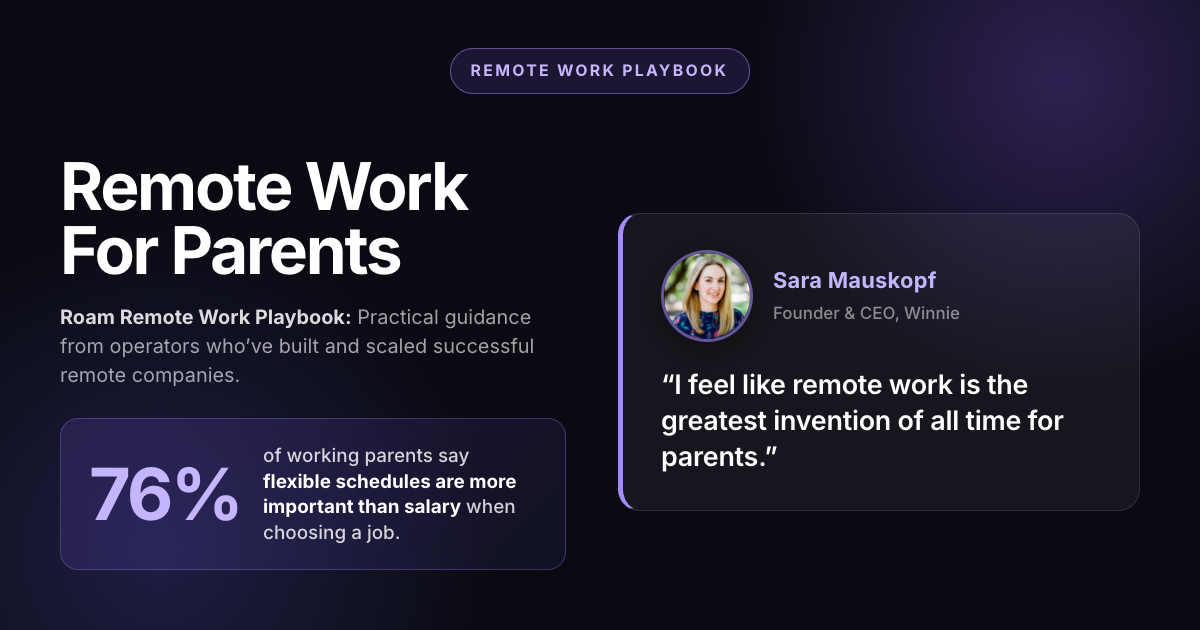
Part of the Roam Remote Work Playbook: Practical Guidance from operators who’ve built and scaled successful remote companies.
76% of working parents say flexible schedules are more important than salary when choosing a job.
Sara Mauskopf, CEO and Co-Founder of Winnie, a childcare marketplace that has helped parents find daycare and preschool for more than a decade. She has led Winnie through both in-office and fully remote operations, giving her firsthand experience balancing remote work, childcare, and team management. The insights in this guide are based on her experience building and operating a remote-first company while serving working families.

“I feel like remote work is the greatest invention of all time for parents.”
-Sara Mauskopf
Key Takeaways
- Remote work doesn’t eliminate the need for childcare, it makes childcare logistics easier to manage.
- Flexible schedules expand childcare options by giving parents more control over hours and location.
- Companies that measure outcomes instead of hours tend to create better experiences for parents and everyone else.
- Trust and visibility outperform rigid attendance policies in remote teams.
- Eliminating the commute gives parents back time, energy, and focus not just hours.
How Remote Work Reduces the Stress Around Childcare
One of the biggest misconceptions about remote work is that parents no longer need childcare. In reality, a parent working full-time from home still needs someone else caring for their children during working hours. What remote work changes isn’t the need for childcare, it’s everything around it.
Without a commute, parents gain flexibility at the beginning and end of the day. School-drop offs, pickups, half-days, doctor’s appointments, and the occasional sick day become easier to absorb without derailing the entire workday. Instead of operating on a schedule with almost no margin for error, remote work introduces breathing room.
Mauskopf describes remote work as adding “slack” to the system rather than replacing childcare itself. That slack is what makes working parent life more resilient. Small disruptions that might have required taking time off in an office-based role can often be handled with a minor schedule adjustment instead.
The distinction matters because it shapes better workplace policies. Companies that assume remote parents don’t need childcare set unrealistic expectations. Companies that recognize remote work simply reduces logistical friction are more likely to build policies around flexibility, trust, and outcomes rather than fixed hours.
Flexible Schedules Create More Childcare Options
When parents start looking for childcare, it’s natural to focus on finding a provider with flexible hours. But in many cases, the bigger advantage comes from flexibility on the parent’s side.
A rigid office schedule narrows the field. If childcare has to line up exactly with commuting hours, drop-off windows, and pickup times, many otherwise good options become impractical. Remote work changes that equation by giving parents more control over their own schedule.
As Mauskopf explains, the more dimensions a parent can flex on, the easier it becomes to find childcare that works. Those dimensions include:
- Hours: Flexible work schedules make it easier to accommodate providers with narrower operating hours.
- Location: Without a daily commute, parents can consider childcare closer to home instead of along a commuting route.
- Price: A wider budget opens up additional options if needed.
- Curriculum or Program Style: Being flexible on educational approach can further expand the pool of available providers.
The more flexibility parents have across these dimensions, the larger the pool of viable childcare options becomes.
The Best Remote Work Policies Don’t Treat Parents Differently
It’s tempting to create separate remote work policies for parents. In practice, the strongest remote companies usually don’t. Instead, they build flexible policies that work for everyone.
Rather than tracking exact hours or requiring permission to step away for everyday responsibilities, remote-first teams set clear expectations around availability, communication, and results. This approach benefits parents, but it also benefits everyone else. Employees without children can have appointments, caregiving responsibilities, and personal obligations too. A policy built around trust and outcomes is simpler to manage—and fairer than one with special rules for different groups.
One expectation doesn’t change: full-time remote work still requires full-time childcare. Flexibility makes it easier to manage childcare that’s already in place; it doesn’t replace it.
Why Trust Beats Time Tracking in Remote Teams
Many companies worry that giving employees more flexibility will lead to less work getting done. In practice, remote-first teams often find the opposite.
When employees are trusted to manage their own schedule, they’re more likely to take ownership of their work. That means stepping up during a deadline, covering for a teammate, or looking back after hours when something urgent comes up—not because they’re being monitored, but because they’re treated like adults.
As Mauskopf puts it, “We hire adults because we expect that it goes both ways.” Trust isn’t just a management philosophy; it’s a practical way to build accountability.
The best remote teams pair trust with visibility. Everyone can see who’s available and who’s stepped away, so work keeps moving without managers needing to count hours or constantly check in. For parents, that visibility matters just as much as flexibility itself. Stepping away for school pickup doesn’t mean disappearing from the team—it simply means they know when you’ll be back.
Why Eliminating the Commute Matters More Than You Think
When people talk about the benefits of remote work, they often focus on the time saved by skipping the commute. For parents, the bigger benefit is everything that comes with it.
A commute isn’t just 30 or 60 minutes in the car. It’s getting everyone out the door on time, coordinating drop-offs, packing lunches, navigating traffic, and making every transition happen on schedule. Even a short commute adds layers of planning and stress before the workday has begun.
Removing that overhead gives parents more than extra time—it preserves energy and focus. Instead of starting the day already behind schedule, they begin work with fewer interruptions and more flexibility to handle the unexpected.
For parents, eliminating the commute isn’t just a convenience. It’s one of the biggest reasons remote work feels more sustainable over the long term.
The Right Tools Make Flexible Remote Work Possible
Flexible policies only work if teams have enough visibility into each others’ availability. Without it, managers often fall back on scheduled meetings, status updates, and tracking hours to understand who’s working and who’s not.
The best remote teams replace that uncertainty with visibility. Employees can step away for school pickup, focus time, or an appointment without disappearing from the team because everyone can see who’s available, who’s heads-down, and who’s away.
That’s the problem Roam is designed to solve.
Instead of relying on calendar invites for every conversation or a static status indicator, Roam gives teams a live view of who’s around and makes it easy to drop into quick conversations when someone is available. The result is a workplace built around trust rather than surveillance. Teams spend less time coordinating and more time collaborating—one reason companies using Roam average eight-minute meetings instead of the traditional 30-minute calendar block.
Remote work doesn’t succeed because people are at home. It succeeds because the right tools make flexibility possible without sacrificing visibility or accountability.
Frequently Asked Questions
Does Remote Work Eliminate the Need for Childcare?
No. Parents working remotely still need childcare if they’re working full-time. Remote work doesn’t replace childcare—it makes scheduling and managing it easier by reducing commuting time and giving parents more flexibility.
Should parents be allowed to block off school drop-off and pickup times?
Yes, as long as they are meeting expectations and communicating availability. Remote work isn’t about being online every minute of the day; it’s about giving people the flexibility to manage their time while still delivering results.
What’s the Most Important Factor in Finding Childcare as a Remote Parent?
The biggest advantage is flexibility on the parent’s side. Being open on hours, location, price, and curriculum expands the pool of childcare options more than relying on a provider with flexible hours alone.
Should Remote Companies Track Exact Hours for Parents?
In most cases, no. The strongest remote teams measure outcomes rather than hours worked, applying those same expectations to everyone instead of creating separate policies for parents.
What’s the Biggest Underrated Benefit of Remote Work for Parents?
Eliminating the commute. It’s not just the time saved—it removes the planning, transitions, and daily logistics that surround a commute, giving parents more time, energy, and focus.
The Bottom Line
For remote companies, the lesson is simple: build systems that prioritize outcomes over hours, make availability visible, and give employees the flexibility to manage their workday. Those practices don’t just support parents, they make remote work better for everyone.