
AI Agents Need an Office
June 8, 2026
As AI agents move from assisting individuals to serving entire teams, their form must evolve.
Just as DOS terminals became graphical interfaces, agents will need richer, more visual ways to be understood and controlled. Some agents will be named and personified. Some will interact through voice, video, and visual understanding. Others will feel more like specialized programs: an “invoice analyzer,” a “lead researcher,” or a “customer onboarding assistant.” There will not be one universal agent interface. There will be many.
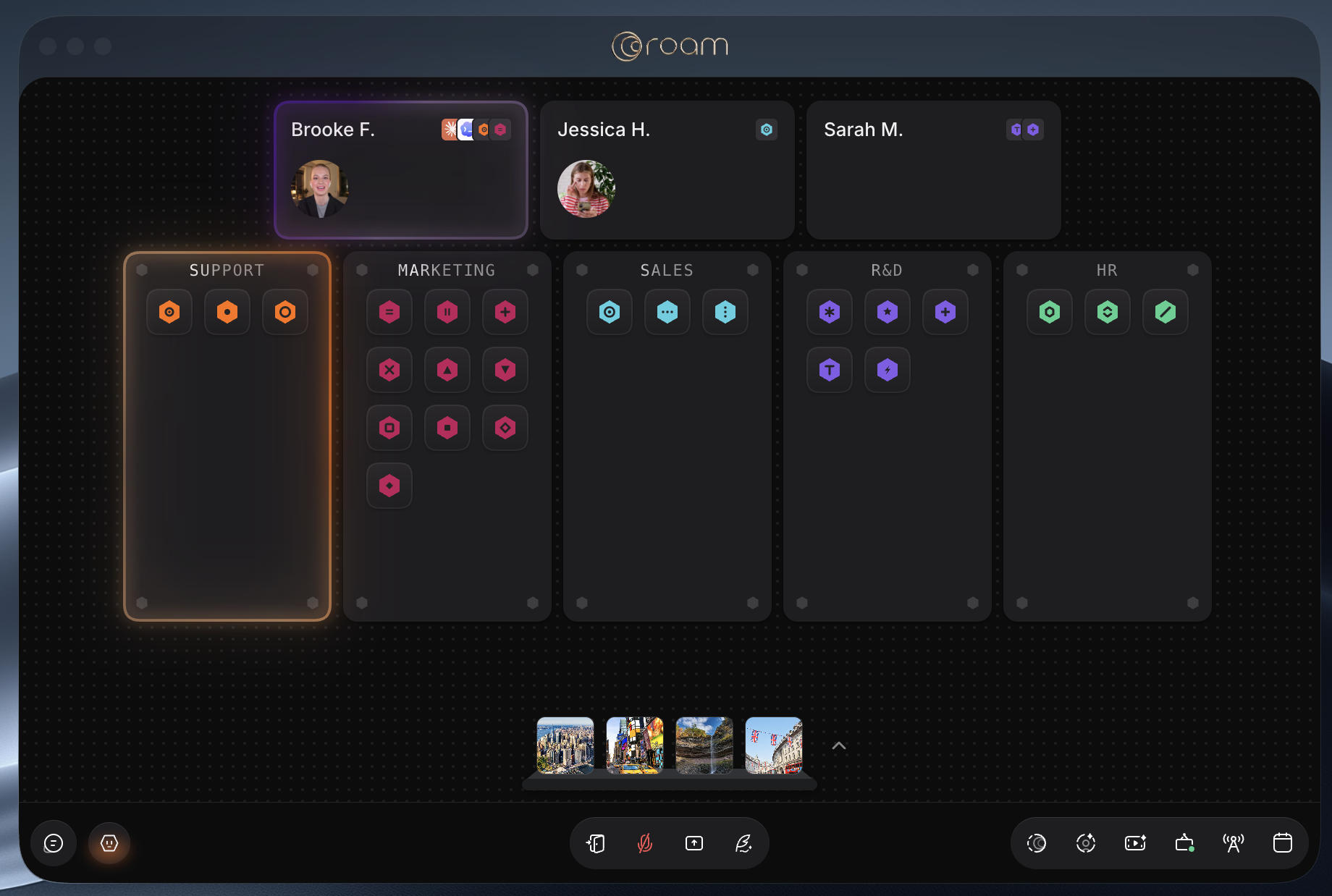
For humans, the physical office has always served as the collaboration hub. An office is full of signals: who is present, who is busy, who is working together, what energy is in the room, and where momentum is building. Ideas emerge not only in formal meetings, but from glancing up from deep work, overhearing activity, running into someone, or casually bouncing around an idea. The simple sight and sound of people working creates energy. Ambient presence matters.
That is one of the core ideas behind Roam’s Virtual Office: presence, office buzz, casual meetings, and the ability to see and feel work happening.
But as more deep work is picked up by AI coworkers, companies will need the same kind of visibility into agent work.
Which agents are running right now?
What tasks are they working on?
Which agents has my team created?
Which agent skills already exist somewhere else in the company?
Which agents need human input?
Which agents are blocked?
Which agents should join a live meeting?
This becomes even more important when agents require humans in the loop. Sometimes an agent may need feedback from a specific person. Other times, it may need any available human with the right context. And sometimes agents will need to work synchronously with a team, inside a live meeting, not merely after analyzing a transcript.
Now turn the question around and look at it from the perspective of the agent.
How does an agent know which people are available?
How does it know who is in a meeting right now?
How does it know when a team is actively collaborating?
How does it know where to ask for help?
If agents were people, these questions would be solved by the physical office. But AI agents are not people. They have no physical form. They are inherently remote.
But they do have a virtual form.
An AI agent runs on a computer. It can be represented visually on a computer. It can be shown to a person, a team, or an entire company. And in a shared team environment, humans should not only be able to see what agents are doing, but also interact with them, assign them work, join them into meetings, unblock them, and reuse their skills across the company.
That is why we believe AI agents should be visualized inside a Virtual Office.
The office of the future will not just be a place for people to work together. It will need a place where people and AI coworkers can see each other, understand what is happening, and collaborate in real time.